Wednesday, July 11, 2012

Hands across Hanover Street

Next Friday, July 20, we are opening our remodeled Community Media Lab, one of a dozen or so open newsroom projects of Digital First Media, parent company of The Mercury.
The lab, once offices of The PennyPincher, has been remodeled and refurnished into a coffeehouse atmosphere. We're not quite finished but when we are, it will be equipped with computers, microfilm, Internet TV and free Wi-Fi.
The grand opening next Friday is being held simultaneously with the opening of a new Pottstown Visitor's Center across Hanover Street from our entrance.
Pottstown Borough Council approved our request to close the block of Hanover Street for part of the day so we can stretch a ribbon across the street between the two sites for a joint ribbon-cutting ceremony.
We'll have food donated by local restaurants at the visitor's center, which is home to the Pottstown Downtown Improvement District Authority and the Main Street manager, and more food (DESSERTS!) in our media lab.
The joint ribbon cutting will include speeches by Pottstown Mayor Bonnie Heath and Digital First Media Director of Community Engagement Steve Buttry, among others.
***
We learned in early spring that we were named as one of the sites for a DFM-sponsored community outreach project. The impetus for our selection was the success of our community food drive that collected more than 16,000 food items and nearly 700 bottles of laundry detergent in just five weeks. The food drive showcased the partnership of The Mercury and community bloggers with the greater Pottstown area community to accomplish a goal.


As we began working on our remodeling plans, we also learned that PDIDA and Main Street Manager Sheila Dugan were planning a similar remodeling across the street in the building that was the first home of this newspaper when it was founded in 1932 and was later site of Longacre's Jewelers and then a podiatrist's office. We decided to cross the street, bridge the divide and join forces with the downtown business group to reach out to our community.

"Someone had a vision of people working, collaborating and succeeding together in a place that promoted our community."


The theme of our joint ceremony is to reinforce old partnerships and introduce a new initiative in both community engagement and improvement.
Part of the emphasis in our grand opening is the "Buy Local" campaign growing in popularity in U.S. towns like this one.
The opening of our Community Media Lab is part of a two-day downtown Pottstown promotion focused on a Sidewalk Sale on Saturday, July 21. Our new site will be open to the public, and anyone who brings a receipt from shopping local that day will get a chance to win prizes in the downtown raffles being conducted throughout the sale event.
***
The Community Media Lab was designed to celebrate this newspaper's relationship with the town and surrounding area. We are opening our archives to visitors and making available microfilm of 80 years of publishing. On the walls is a photo display of some of our favorite newspaper photos over the years, reflecting life in the towns we cover. We will have free Wi-Fi, Internet TV, coffee and cold drinks available, a lending library of books (with recommendations for reading from our editors and bloggers) and computers for public use.
The space can be used to blog, work on a resume, research. You can ask us for help starting a blog, you can schedule a meeting of your writers group, you can knit, you can read, or you can just stop in to say hi, pick up a map of the Schuylkill River Trail or post a help-wanted notice on the Community Share bulletin board.
The Mercury has been a resource used in the lives of our readers for 80 years; this opening marks the start of a new era of engagement and working together.

"Hands were joined, ideas were shared and what started as an idea has become a partnership dedicated to a commonly held faith in new growth and new vitality for Pottstown."

Please join us. 


Thursday, July 5, 2012

Pedaling, paddling, Pottstown

Some things I learned last Saturday:
-- Paddling a kayak can be more difficult than it appears. Or, I'm just not coordinated.
-- The village of Douglassville, now a massive-area mailing address, was founded by an English Quaker George Douglass whose home in the 18th century is the mansion under restoration I pass every day on my bike ride to work.
-- George Washington stopped twice at the White Horse Inn in Morlatton Village for a meal or a drink. He didn't sleep there.
-- Bause-Landry Catering makes the best boxed lunch. (I already knew that; it was just re-learned.)
I learned these things while participating on the Pedal-Paddle event sponsored by the Schuylkill River Heritage Area. I also learned about some planned events the SRHA is working on, including a cycle and cemeteries tour for the Civil War 150th anniversary.
The Pedal-Paddle started with gathering at the Heritage Area headquarters at Riverfront Park to bike 4.5 miles on the Schuylkill River Trail to Morlatton Village. At the village, a guide from the Historic Preservation Trust of Berks County conducted a tour of the Mouns Jones House, White House Tavern, former Covered Bridge Keeper's House and an explanation of the Douglass mansion, though it was not open due to ongoing renovation.
Then, we biked to Ganshahawny Park where a boxed lunch was served, kayaking instructions were given, and we set out on the river to paddle back to Pottstown.
The cost of the day's events were $25 and included use of a Bike Pottstown yellow bike, lunch, kayaks provided by Kelly's Canoes and Kayaks -- and lots of free and useful information.
Special thanks to Chris from Kelly's who paddled alongside in an attempt to convince me I was not as woeful a kayaker as my wandering route indicated.
Calm and confidence is key to success in everything. I learned that, too.

Thursday, June 28, 2012

Tale of two forest fires

It's been just two months since a forest fire in the French Creek State Park and Hopewell area gamelands caused an evacuation of homes along Sycamore Road in Union Township and St. Peters Road in North Coventry. At the time I told my brother who lives in the Black Forest area of Colorado that I thought forest fires were more a threat to his home than to mine.
This week, I recalled those words, as well as my own evacuation dilemmas, as I called him to check on his household amid the raging Waldo Canyon fires.

My brother, Jim Egolf and his wife JoAnne live on the north side of Colorado Springs in the middle of usually tranquil forest, Pike's Peak visible from their deck.
He assured me this fire is too far off to endanger their home, but they are concerned nonetheless. The entire state is like a tinderbox, he said, and the concern is that one lightning strike, one errant spark from a target shooter, one cigarette butt, one careless act of burning could consume their side of the city as well.
"It's not this fire we're worried about," he said. "It's fear of where the next one breaks out."
They spent Wednesday night mapping out an evacuation plan. JoAnne took photos of belongings -- furniture, appliances, china and keepsakes -- for insurance purposes should they be destroyed. They went room to room, deciding what to take and what could stay behind.
"She's like you and wants the sentimental things," he laughed. "I think of the practical stuff and want to make sure we have all the financial records."
The conversation was somewhat surreal: I talked about my experience April 10, hurriedly taking the computer tower, the dog and the lockbox. He talked about their plans to fill two cars with the necessities, (the dog) and if they had enough time, make a second trip for more possessions.
The situation in Colorado is more massive, encompassing and threatening than our stubborn woods fire in April, but the similarities are striking.
"The help people offer each other is amazing," he said. I recalled how a stranger reached out to me on Twitter the night of our evacuation offering to pet-sit Sydney.

In Colorado Springs, the food banks asked for help, and then asked people to stay away because the line of cars to donate food was creating a traffic jam. Here, St. Peters Road residents closest to the fire cooked meals for the volunteer firefighters to show their appreciation.
He told me friends visiting from back East last week took the train up to Pike's Peak, and from the summit saw a tiny plume of smoke in the area of Waldo Canyon. By the time they reached the bottom of the mountain, the black smoke was filling the sky.


Here, in April, the scanner report in the newsroom that a brush fire had broken out was followed about an hour later with calls that smoke was seen as far as Limerick.
In both cases, strong winds and the "tinderbox" conditions caused by severe drought combined to fuel a terrifying force of nature as flames moved quickly along ridges and through valleys.
Jim told me elderly people are having breathing problems. Someone he knows was coaching an adult softball game when one of the players had a heart attack. His golf league suspended play this week because of air quality.
He said his phone has been busy with friends and family back East calling to check on them.
His account matched the experiences other local transplants to Colorado Springs have posted to The Mercury Facebook page. Most people are in their homes, safe, just as most people in the Pottstown area were safe at home during the April fires here.
We're still affected though. The reality check of looking around your home to consider what you'll miss most should it go up in flames is an experience that stays with you. It's now an experience my brother and I share.

Monday, June 25, 2012

Telling veterans' stories: The least we can do

"Grant Cantrell is no longer in Afghanistan, but the peace and quiet of his North Coventry home is not enough to erase the horror he has seen, or the intense pain in legs doctors once wanted to remove."


Those words last Friday introduced a front-page story written by Brandie Kessler and photographed by John Strickler about a local war hero and his rehabilitation from injuries suffered in Afghanistan. It was not the first time the Purple Heart recipient was featured in The Mercury. We learned of Cantrell's return home when covering a welcome-home ceremony at Ludwig's Corner Horse Show grounds attended by a crowd who witnessed the emotional moment of this young Marine walking toward his mother, the first time since his injury she saw him walk unassisted.
Our staff, particularly Brandie and John, have written/photographed a number of homecoming ceremonies for returning soldiers, Marines and airmen. Our proximity to A Hero's Welcome, the organization started by Pottstown woman Sharon Hyland-Keyser and kept going by her mother Maria Hyland of Lower Frederick, and Brandie and John's sincere admiration for those who serve our country inspire many story pitches for coverage.
It's impossible to say no.
These stories and many others are also part of the American Homecomings website, a yearlong project of Digital First Media. Cantrell's story was the centerpiece of the website last week. Brandie's original feature on A Hero's Welcome remains one of the top-read stories on the national site, and a photo feature by John with another story by staff writer Frank Otto set the stage for the site's poignant coverage of Memorial Day across the U.S.


The stories of our returning servicemen and women are not always easy to read. And Brandie and John will tell you they are not always easy to report and photograph. These are stories of pain and readjustment, of futures shattered and dreams broken.
They are stories we need to hear, however.
As Americans, the least we can do for those who sacrifice for us is to take the time to learn about their struggles and honor their commitment. The least we can do is to take time to better understand what it means to leave here with a future intact and return to uncertainty.
The sacrifices are not only in physical injury but also in mental and emotional damage, in jobs put on hold, in education interrupted, in family moments missed and in experiences that alter a person's view of the world.
The least we can do for those who sacrificed is to seek understanding and to lend a helping hand.
AmericanHomecomings.com

Thursday, June 14, 2012

Charging forward

I read this analysis of the changing newspaper industry recently after one of my Digital-First Media bosses Steve Buttry pointed to it in a blog post: This I Believe ... by Tim McGuire of the Arizona State University Walter Cronkite School of Journalism and Mass Communications.

I also recently led a panel discussion at the Pennsylvania Press Conference sponsored by four state newspaper associations in Gettysburg on "Doing it All: Tips from old-school journalists in the digital age." The highlight was York Daily Record photojournalist Jason Plotkin, outfitted with bulletproof vest, hip waders, and an iPhone, reminding us that he is a pro who does not sacrifice quality in the name of a blogger with a Flipcam.

That evening (June 2) was the annual awards banquet sponsored by the Pennsylvania Newspaper Association and Pennsylvania Newspaper Editors Association. Three hours of speeches more or less followed the theme: "Our business is struggling but thanks for this award that notices we're still trying." At the conclusion of the speeches -- yes, it really lasted three hours -- the Harrisburg Patriot-News and The Philadelphia Inquirer were honored as the two Pennsylvania media organizations that won Pulitzers this year for local reporting and public service. Their introduction and standing ovation was, as we say, a buried lead. The example of reporting excellence belongs front and center -- first, not last, in a year's retrospective of our profession.

These experiences got me thinking.

As I returned home that Sunday and to the office Monday, I was confronted by the mistakes an overworked copy desk misses on the front page, the bad headlines that get on to the web when the send button replaces a second read, and the uninspired content that comes from doing things the way we've always done them, even with new, faster digital tools and techniques.

But I also saw good work, much of it sadly taken for granted -- by us in our presentation and by our readers who are looking for something more immediate.

I decided it was time to stop talking about how change is pushing us, and instead, change how we're being pushed.

In the words of another media analysis, I don't want us to be "cranking out just enough rickety junk to keep words and pictures around the remaining ads" of a shrinking newspaper. ("Sustainable Quality" by Dan Conover)

Monday I wrote this staff memo:
"While I am forever encouraging people to think differently about how we do our jobs, I need to do some of that as well. After some discussion with others, it seems we cover high school graduations with story and photos just because that’s the way we’ve always done it. Starting now, we’re changing."

Tuesday I came into work earlier -- not to write another editorial or play on Twitter, but to sit still and plan how to best present to the readers of The Mercury and the audience at pottsmerc.com a meaningful look and analysis of the world in which they live.

I don't want us to crowdsource a reaction story to property tax reform on Facebook if we don't also provide a data analysis of how property tax has affected your households and your schools.

I believe we need to stop recounting the timelines of every crime and the events leading up to an arrest and start providing some perspective on the toll that crime takes on your neighborhoods.

I believe community engagement must go beyond being liked by a couple thousand people on Facebook. Being involved with the community means working together for good, not just sharing words and photos.

I want this newspaper and all its new and varied platforms to be an instrument for change in Pottstown and the surrounding area. I want people to discover in the print edition a reader's joy in experiencing a well-crafted story. I want the website to reflect the life of the towns we cover as vibrant, sometimes tragic, events and moments.

If we are to embrace change and grow, we can't be stuck trying to do things the way we've always done them and just add video. We can't write a slew of boring stories and pat ourselves on the back because we had a conversation with readers on Facebook or because we blogged a few times.

If I am going to ask others to look at their work as opportunity instead of burden, it starts with me. I believe that this newsroom is an amazing group of journalists who every day rise above the limitations of our industry. They report on this community with creativity, passion and accountability. What we need to do better is sharpen our presentation and follow with conviction our core values of telling the good story, fighting the important fight, and inspiring progress in the towns and schools we cover.

During the past two weeks, I've been busy writing memos, marking up papers and analyzing our work. If you read The Mercury in print, you may have noticed some bolder page designs, more colorful pictures, better packaging of news. If you follow pottsmerc.com online, you saw our photo galleries of high school graduations and our blog Schuylkill River Sojourn that traveled along with this year's 112-mile trek down the river.

I didn't give a speech at this year's awards banquet because we didn't win any major awards. If we had -- if I did -- it would be to say I believe in local journalism and this newsroom's ability to deliver it.

Keep an eye on us.


Thursday, May 31, 2012

Read this, Mr. Governor

Pennsylvania Gov. Tom Corbett came to Montgomery County this week for an editorial board meeting with a group of editors from our Philadelphia area Journal Register Company newspaper group. Four of us -- me, Stan Huskey, editor of The Times Herald; Phil Heron, of Delaware County Daily Times, and Andy Hachadorian of the Daily Local News - alternated with questions to the governor in a videotaped, live-tweeted, photographed interview session. Reporters and other editors from our papers, plus The Trentonian and the York Daily Record/Sunday News joined the hour-plus session.
Corbett was more engaging, more personable than we expected from a governor who is being criticized within his own party for not working hard enough on relationships or getting out in front of people on issues.
He was also more evasive than we anticipated with actual answers to our questions. (News story is here)
But on one point, he was both personal and clear: In reply to a question about what he plans to do about the pension crisis in Pennsylvania, he suggested that the media should do more to highlight the problem and pressure legislators for action.
My reply: "We've all written those editorials."
His reply: "You and I read editorials; no one else does."
Though a surprise, considering the audience, and somewhat deflating, considering the speaker, Corbett's frank comment was not off-base.
Although I am a steadfast champion of the weight of an editorial voice to a daily newspaper, in recent years I have become less certain of the power of that voice to accomplish change.
People comment on editorials, it seems, when they support something they also support. But rarely if ever do I learn that an editorial changed opinion or reversed a course of action.
Corbett went on to say we should be writing news stories that explain the pension problem as opposed to editorials that advocate change.
Is the difference that news is on the front page versus the third-from-the-back-of-the-front section Opinion page? The Breaking News bar versus the Opinion dropdown on a website? Does a news story rank higher in a Google search than an Opinion piece?
When a newspaper writes a front-page editorial, as The Reading Eagle did on May 20, it gets attention, at least among other editors. The Eagle broke out of its consistent design to take over the front page on that Sunday with an editorial, "Take Charge," calling on the mayor and city leaders to address the problem of violent crime and its effect on the city and its reputation. Did it have an effect, inspire action?
The Harrisburg Patriot-News last year won nationwide acclaim for a full front-page editorial calling for Penn State Board of Trustees President Graham Spanier and football coach Joe Paterno to resign for their roles in failing to address or to cover up the alleged sex abuse charges against former football defensive coordinator Jerry Sandusky. Paterno and Spanier were both removed from their jobs the next day. Did the editorial influence those actions?
The Mercury has printed front-page editorials twice in the past decade, the first to call for public response in the wake of the 2005 late-night pay raise by Pennsylvania legislators. The second one was to push for change in teen driving laws to impose passenger limits after four local teens died in two crashes.
In the first case, the pay raise was repealed months later after an aggressive citizens campaign. The Legislature eventually passed teen driving laws more than a year after our editorial insistence they do so.
Are we, as the governor implied, voices in the wind?
The power of a newspaper editorial has changed, I believe, along with the changes in our industry. Opinion pieces don't go viral in the way a YouTube video of a baby in a washing machine might.
The measured words of a newspaper editorial are easily set aside and forgotten, while a blogger's rant is retweeted around the world.
Is the Opinion page of a newspaper falling by the wayside on the digital highway?
While the governor was talking with our group yesterday, at least five people in the room were tweeting quotes. The coverage was retweeted by online editors back in our newsrooms, collected with hashtags and gathered into a Storify stream. The audience for those tweets easily reached into the hundreds of thousands.
Video cameras captured the action for at least five websites with a total potential audience of nearly 15 million people a month.
You're right, Mr. Corbett, fewer people are reading the editorials. More, however, are getting our message.
That's why I wrote this blog.


Monday, May 14, 2012

Cleaning up what others leave behind

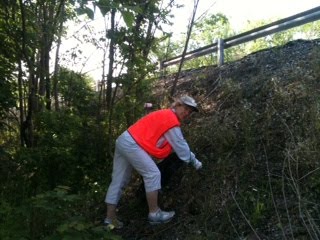
Mother's Day morning turned out to be a beautiful day to spend two hours cleaning up the riverfront park, Ganshahawny -- that's Lenape for Tumbling Waters -- Park along Old Reading Pike in Douglass (Berks) Township. Fifteen volunteers including three people joining The Mercury newsroom crowd after reading about our community engagement effort gathered at 8 a.m. to clean trash out of the park. The effort was put together by Diane Hoffman, Mercury community engagement editor, and the site was chosen by readers' suggestions.
We donned our orange vests, put on work gloves, and with trash bags in hand, fanned out around the park.
Cleaning up in a public area like this one teaches a lot about human habits.
People don't like to pay the fee charged by disposal companies to get rid of tires. They prefer to throw them in the river, in the woods, or in swampy areas where flooding can cause them to be buried in mud.
People driving on Route 422 eat and drink while driving, and they get rid of their trash on the spot. McDonald's bags, Starbucks and Wawa and Dunkin' Donuts cups were everywhere. We found beer bottles, plastic soda bottles, candy wrappers and articles of clothing.
I cannot understand how anyone driving along the highway, surrounded by green hillside and woodland, can toss trash out the car window as if nature is a garbage bin.
In my Mother's Day frame of mind, I can only surmise they weren't raised right.
(Later in the day I asked my younger son, who has a penchant for Starbucks drive-throughs, if he would ever throw a coffee cup out the car window while driving, but even as I was saying the words I pictured the interior of his car. I know he doesn't litter coffee cups, water bottles or protein bar wrappers -- he collects them on the floor of the backseat. That's OK; he's not violating anyone else's space.)
Come to think of it, we didn't find much litter to match a healthy lifestyle. The wrappers were for Kit-Kats, not protein bars; bottles were Coke, not water; fast-food containers were fries, not salads.
Food waste wasn't all we found.
People treat the outdoors as a disposal site for large pieces of plastic, water softener salt bags, broken wheelbarrows, and bags of unwanted clothes.
There's a fair amount of hanky-panky going on in those speeding cars, judging by the beer bottles, condoms, underwear and even a wine carafe along the 422 bank.
Not raised right, indeed.
The group of newsroom volunteers cleaning up the park Sunday did a tremendous job of cleanup, working hard under the sun and ignoring the distraction of poison ivy and the discovery of two snakes, one of them a suspected poisonous copperhead.
Among the group were moms who could have been sleeping in, dads and sons and daughters who could have been taking their wives/mothers out to brunch, young people who could have been enjoying the beautiful day in sports, hiking, motorcycle riding or any activity certainly more enjoyable than picking up after others.
Working alongside my newsroom crew made me proud.
A word to all their mothers: You raised them right.